Bluegill & Shellcracker on Watts Bar Lake
TWRA describes bluegill as a good quantity fishery (more quantity than quality), with prolific spawning that can occur up to three times a year. Redear (shellcracker) are present, but Watts Bar is not a standout shellcracker destination compared with downstream Chickamauga.
Biting now
Largemouth Bass, white, Crappie
Best bet Backs of creeks, grass edges, bait migrations
Loading…
Updated 4:48 PM ET · Dock station at TRM 559.5Full live conditions →
Water, air, and wind from the dock sensor. Lake level, generation, and outflow from TVA telemetry. No forecasts.
Where they live by season
| Season | Depth | Where |
|---|---|---|
| Winter | 10–25 ft | Deep docks, bluffs, creek channels |
| Pre-spawn | 5–12 ft | Gravel/shell/rock banks, docks |
| Spawn | 2–10 ft | Bedding colonies on gravel/shell, gradual rock |
| Post-spawn | 5–15 ft | Docks, weeds, mayfly banks |
| Summer | 2–12 ft | Docks, mayfly hatches, shoreline shade |
| Fall | 6–18 ft | Docks, channel edges, bluffs |
If you had one day
- Use polarized lenses to scan for shell/gravel colonies in 5–10 ft from late April through early June.
- If not bedding, fish the deepest shady dock or bank combination in the same creek.
- Around mayfly hatches, move fast and cast small topwater, fly bugs, or light jigs to surface activity.
Lure matrix
| Condition | Bait | Color |
|---|---|---|
| Bedding fish | Worms, crickets under float | Natural bait |
| Active summer fish | Tiny jigs, fly tackle on mayflies | Black, chartreuse, foam bugs |
| Deeper fall/winter | Split-shot + worm | Natural |
Identification and biology
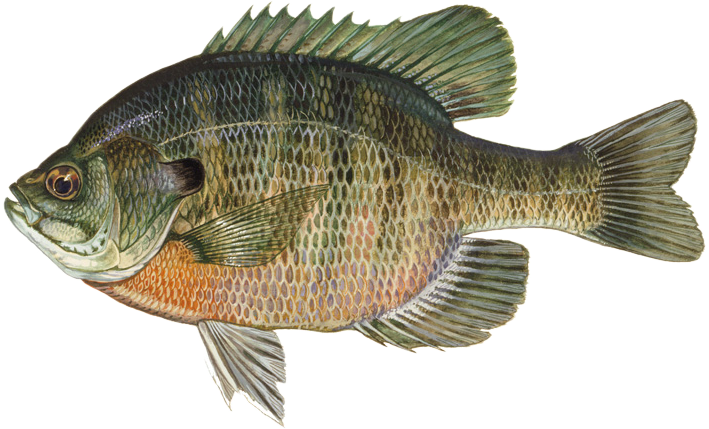
Lepomis macrochirus. Other names: bream, brim, sunfish, sunperch, redbreasted bream, coppernosed bream. Defining features: deep flat body shaped like a small pancake, deep blue-purple gill plates, a black "ear" tab on the rear edge of the gill cover, fiery orange-yellow belly, and a small terminal mouth.
Bluegill spawn in shallow water in colonies; their beds are circular depressions in gravel or shell, usually grouped together. They can spawn up to three times per year on Watts Bar (per TWRA), starting late April. Spawn temps run 67 to 80 °F.
Diet: insects principally. Fry eat rotifers, copepods, and chironomid larvae; adults eat aquatic insect larvae (mayfly, caddisfly, dragonfly, damselfly), zooplankton, crayfish, small fish, and occasionally vegetation. Adults consume about 3.2% of body weight per day in summer.
Average TN harvest: 7 inches; range 4 to 11 inches. Lifespan typically 5 to 8 years.
Bluegill have two reproductive strategies. Large parental males (mature around age 7) build and defend nests. Smaller satellite males (mature around age 2) mimic females and sneak fertilizations. The strategy is genetic and persistent; it explains why some old bluegill colonies have wildly different size distributions.
Redear sunfish (Lepomis microlophus), also called shellcracker, are present in Watts Bar but at lower densities than bluegill. They prefer warm clear non-flowing water and feed heavily on aquatic snails (giving them the shellcracker name). They spawn once per year in deeper water than bluegill. Watts Bar is not a standout shellcracker destination compared with Chickamauga.
Records and recognition
- Tennessee state record (bluegill): 3 lbs.
- TARP qualifying length: 10 inches (bluegill), 11 inches (redear). A 10-inch bluegill on Watts Bar is achievable on a good summer day around bedding fish.
- Watts Bar limits: Bluegill: no limit, no minimum length. Redear (shellcracker): 20 per day, no minimum length. The most kid-friendly creel rules on the lake.
Live conditions
Today's water temperature, dam generation status, weather, and wind are on the homepage, measured every minute at Tennessee River Mile 559.5. Use those to time the trip. Bass spawn windows are temperature-driven, current-bite patterns are generation-driven, and clarity changes after storm runoff.
Frequently Asked Questions
When is the best time of year for bluegill on Watts Bar Lake?
Late April through early June is the prime window, when bluegill are on beds in 2 to 10 ft of water over gravel, shell, and rock. TWRA notes spawning can repeat up to three times in a year, so another window opens in midsummer. Mayfly hatches also concentrate surface-feeding fish regardless of the spawn.
What gear works for bluegill on Watts Bar?
Worms and crickets under a bobber are the defaults for bedding fish. Tiny jigs and fly bugs for summer topwater and mayfly activity. Split-shot and a worm for deeper dock and bluff fish in fall and winter.
More species