Striped Bass on Watts Bar Lake
TWRA says striped bass have been stocked annually on Watts Bar since 1964, making it a year-round fishery. Best official locations are mid-lake to upper reservoir around Fort Loudoun and Melton Hill, plus Kingston in spring and summer. In fall, Rockwood and White's Creek waters are good starting areas in 10 to 20 ft.
Biting now
Largemouth Bass, white, Crappie
Best bet Backs of creeks, grass edges, bait migrations
Loading…
Updated 4:49 PM ET · Dock station at TRM 559.5Full live conditions →
Water, air, and wind from the dock sensor. Lake level, generation, and outflow from TVA telemetry. No forecasts.
Where they live by season
| Season | Depth | Where |
|---|---|---|
| Winter | 10–30 ft | Main body + tributary arms, tailraces, channels |
| Spring | 8–25 ft | Mid-lake to upper river, Kingston, tailwater regions |
| Spawn period | — | Upstream movement; no successful natural reproduction |
| Early summer | 10–30+ ft | River channels, planer-board lanes, tributary arms |
| Summer | Habitat constrained | Tributary-arm refuge water with hypolimnetic inflow (cooler, oxygenated) |
| Fall | 10–20 ft often | Rockwood and White's Creek areas, shallow bait zones |
If you had one day
- Spring or early summer: launch near Kingston or the upper-mid reservoir. Graph the main channel and adjacent flats. Fish live shad on planer boards first.
- If TVA is pulling current, shift closer to tailwater and current-edge structure.
- If it's a low-pool spring or bait is scattered, don't force stripers all day. Keep a fast-switch option to catfish or white bass.
Lure matrix
| Condition | Bait | Color |
|---|---|---|
| Primary confidence | Live shad / large baitfish | Natural |
| Search tool | Tennessee rig / umbrella rig | White, pearl, shad |
| Fall horizontal bite | Crankbait, swimbait, spoon | Chrome, pearl, sexy shad |
| Tailwater current | Jig, live drift bait | Shad profile |
Summer thermal refuge
Published research (Transactions of the American Fisheries Society) found that summer Watts Bar stripers become restricted to tributary-arm habitats where water stays under 75°F (24°C) and dissolved oxygen exceeds 4 mg/L. Those refuges are linked to hypolimnetic inflows and groundwater inputs, not coincidence. When the main lake heats up, the school disappears into the tributary arms with cool inflow.
Fish-consumption note
Identification and biology
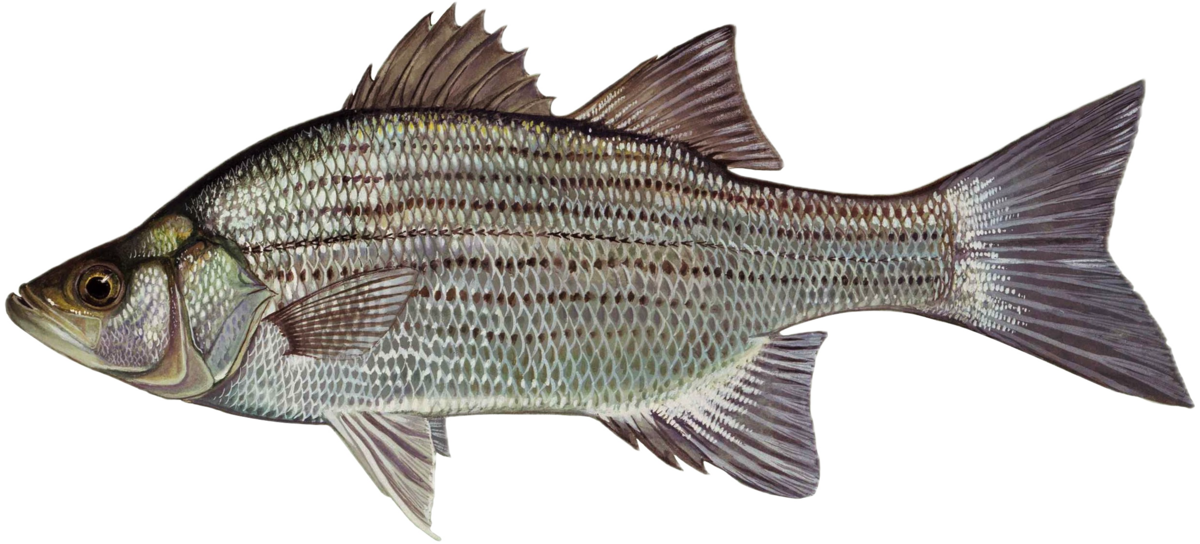
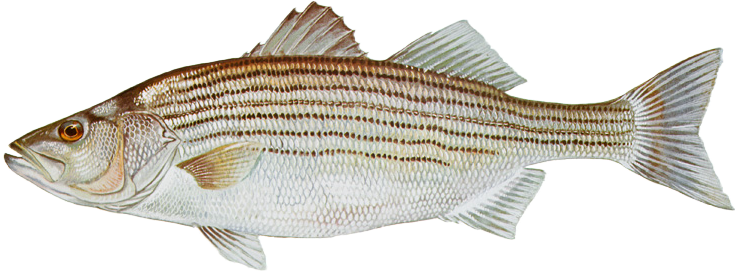
Morone saxatilis. Other names: rockfish, striper, rock, linesides. The defining ID feature is a streamlined silver body with longitudinal dark stripes running from behind the gills to the base of the tail. Distinguish from white bass (smaller, fewer and broken stripes) and Cherokee bass (the hybrid striped × white bass cross, intermediate size and stripe pattern).
Striped bass are anadromous in their native range (Atlantic Ocean and Gulf of Mexico, spawning in fresh water). In Tennessee they exist only where stocked or where they have migrated from stocked waters through dam locks. Watts Bar has been stocked annually since 1964; the population requires hatchery support because natural spawning in TN reservoirs is limited.
Diet: gizzard shad, threadfin shad, and other herrings, almost exclusively. They herd schools of shad to the surface and feed in visible "boils" that signal their location. Diet specialization makes them sensitive to forage availability and water-column conditions.
Average TN reservoir harvest is about 32 inches; range 15 to 40 inches. Adults can live 30+ years; the bigger stripers in Watts Bar are old fish.
Cherokee bass (also called hybrid striped, wiper, sunshine bass) is a hatchery cross of female striped bass × male white bass, named for the first Tennessee introduction at Cherokee Reservoir in 1965. It feeds and behaves like striped bass and is treated under the same Watts Bar creel rules.
Records and recognition
- Tennessee state record (striped bass): 65 lbs 6 oz.
- Tennessee state record (Cherokee/hybrid striped bass): 23 lbs 3 oz.
- TARP qualifying length: 40 inches (striped bass), 28 inches (Cherokee/hybrid).
- Watts Bar limits: 2 per day combined (striped + hybrid). April 1 – October 31: 15-inch minimum on both. November 1 – March 31: 36-inch minimum on striped bass, 15-inch on hybrid; only 1 striper allowed per day in this window.
Live conditions
Today's water temperature, dam generation status, weather, and wind are on the homepage, measured every minute at Tennessee River Mile 559.5. Use those to time the trip. Bass spawn windows are temperature-driven, current-bite patterns are generation-driven, and clarity changes after storm runoff.
Frequently Asked Questions
When is the best time of year for striped bass on Watts Bar Lake?
Spring (March through May) is the prime window: stripers move from Kingston upstream and are accessible by graphing main-channel and tributary intersections. Early summer, before the lake heats above 75°F, extends the opportunity. Summer stripers retreat to cool tributary-arm refuges and are hard to target. Fall (September through November) near Rockwood and White's Creek is the second peak.
What gear works for striped bass on Watts Bar?
Live shad or large baitfish are the confidence choice. Tennessee rigs (umbrella rigs) work as a search tool. In fall, crankbaits, swimbaits, and spoons on horizontal bait balls. In tailwater current, jigs and drift presentations on live bait.
More species